
Peachtree door locks: identify yours and find the replacement
By the Shootbolt team · · Updated
Short answer: Peachtree door hardware depends on when the door was built. All About Doors, a parts distributor, says Peachtree hinged doors used an IPD (Citadel) lock with concealed rods before 2002, then HOPPE multipoint locks with a faceplate running the full length of the door, and briefly an Ashland concealed-rod lock. Check the faceplate and its stamp first.
- Before 2002: IPD (Citadel), rods hidden inside the door
- After 2002: HOPPE, one faceplate from top to bottom
- A few years: Ashland, also concealed rods
- Peachtree HOPPE kits: 5/8 in (16 mm) faceplate, 1-3/4 in (45 mm) backset
- We sell: HOPPE parts only
What lock is on my Peachtree door?
We found no Peachtree document that names its locks. All About Doors writes that "Peachtree doors used 3 different multi-point locks"[1]. (New to these? See how a multipoint lock works.) The year is a guide; the door edge settles it.
| When | Lock | What you see on the door edge | Where the parts come from |
|---|---|---|---|
| Before 2002 | IPD (Citadel) | A mortise lock in the middle and separate modules near the top and bottom; rods hidden inside | IPD parts sellers; we don't sell IPD |
| After 2002 | HOPPE | One long faceplate from near the top of the door to near the bottom | HOPPE parts, matched by measuring |
| A few years | Ashland | Concealed rods, like the IPD lock; read the stamp | Amesbury Truth, which now owns Ashland |
Figure 1 shows the difference. Other makers are in multipoint locks by door brand.
How to tell the three locks apart
Open the door and work on its edge:
- Faceplate length. One strip running most of the door's height means HOPPE. A shorter plate at the handle, with small plates higher and lower, means a concealed-rod lock (IPD or Ashland).
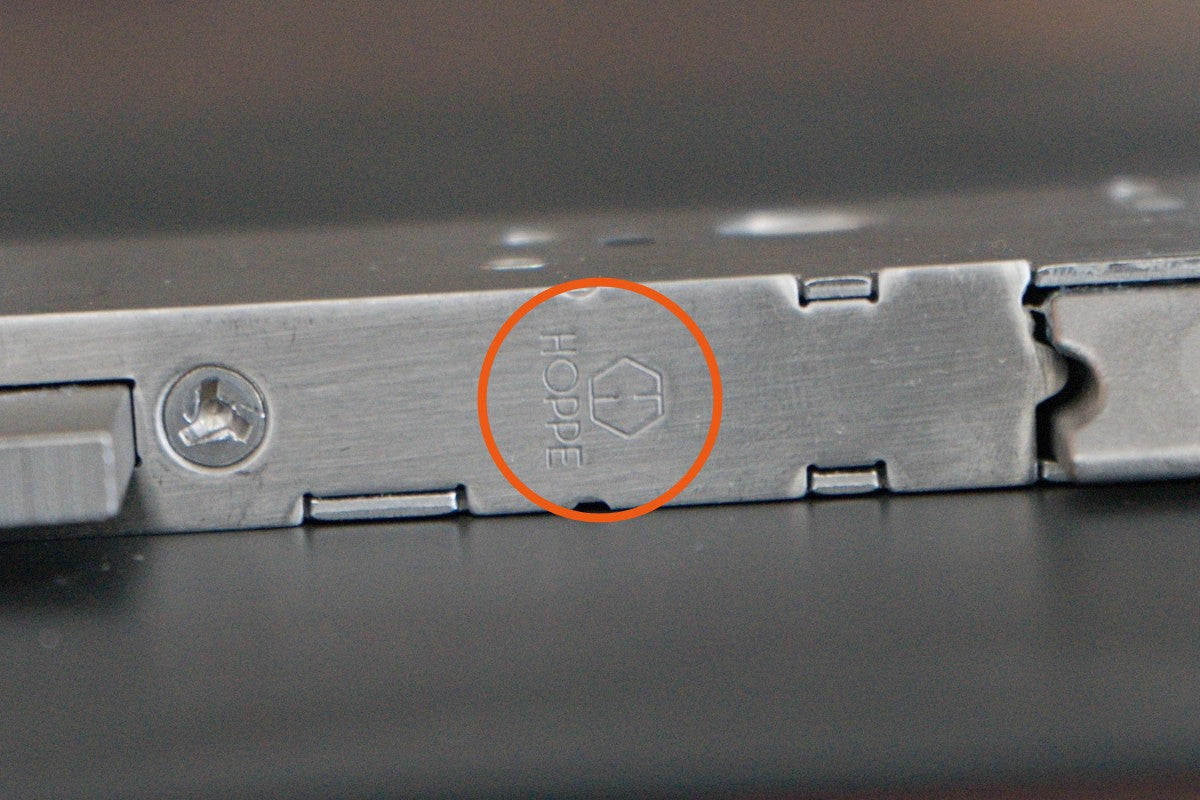
- Stamp. Look near the latch (Figure 2). HOPPE's faceplate shows the HOPPE logo but no part number, so check the box label or paperwork too.
- Faceplate width. The Peachtree-named HOPPE kits use a 5/8 in (16 mm) faceplate[4].
- Backset, faceplate to the center of the handle spindle: 1-3/4 in (45 mm) on those kits (how to measure backset).
- Locking points and height. With the door open, hold in the trigger, a small spring plunger beside the latch, and lift the handle. Measure from the handle center to the lower tongue, and note the door height. Retract every bolt before you close the door.
Locksmith Ledger lists the same set for any multipoint[8]; the full method is in which multipoint lock do I have. If every point throws in that test, the lock works and the door is out of line: see door won't lock.
Peachtree doors with a HOPPE lock
Two distributors sell HOPPE kits named for Peachtree. MPLocks' "Hoppe Multipoint Lock Kit for Peachtree Doors" (49902-1645T-20-Kit) lists[2]:
- a 1-3/4 in (45 mm) backset and 3-5/8 in (92 mm) from handle to key;
- a 36 in (914 mm) handle height and a 1 in (25 mm) deadbolt throw;
- three points: the deadbolt and two tongues, the lower one 24.41 in (620 mm) from the handle;
- a bottom gear (HOPPE 8779123) and a top extension (8779131), for doors 69.3 to 79.8 in (1,760 to 2,027 mm) tall.
For taller doors, MPLocks sells a Peachtree bottom gear kit (4990227-KIT) for doors 91.38 to 95.32 in (2,321 to 2,421 mm) tall[3]. Countryside Locks calls the 8779123 gear "Used by Peachtree and other door manufacturers"[4]. These are seller listings, so compare every figure with your lock.
The 8779123 is an HLS 9000 tongue gear; on HLS 9000 locks the euro (keyhole-shaped) cylinder sits below the handle, per HOPPE's catalog[9]. Decode any number you find with HOPPE part numbers explained, and choose a whole lock or just the gear with which HOPPE gear you need.
If the handle droops or won't lift, often only the gearbox has failed: see replacing only the gearbox. Handle set screws are often 3 mm on HOPPE (sizes by brand: loose door handle fix). Sellers also tie HOPPE adjustable hinges and a München handle set to Peachtree; treat those as leads.
Peachtree IPD (Citadel) locks
All About Doors' repair guide says the IPD lock "is comprised of five (5) components": the mortise lock body, a top and a bottom auxiliary module, and the drive bars joining them[5]. It lists the lock case by hand (37400034, 37400035) and top bars for 6 ft 8 in (2,032 mm) and 8 ft (2,438 mm) doors.
The rods are held by hidden set screws. An IPD repair video reaches them through an access hole with a 3/32 in (2.4 mm) hex key and pulls one bar at a time: if the lock works with the top bar out, the top module is at fault; if not, the mortise lock is[7]. When the deadbolt won't extend, All About Doors drills a small access hole to reach the screws, and says to order the new lock case first, because drilling too deep damages other parts[6].
We don't sell IPD parts. IPD parts sellers list them by the numbers above. For locks no longer made, see discontinued multipoint lock replacements.
The Ashland lock and Peachtree entry doors
All About Doors says Ashland's lock "was used only for a few years" and "also had concealed rods"[1]. Amesbury Truth now lists Ashland's Sentinel parts; match the stamp with identifying an Ashland lock.
We don't sell Amesbury Truth parts at the moment, so the Ashland route is an Amesbury Truth dealer.
Sellers also list Trilennium parts for Peachtree entry doors (weak evidence): see Trilennium multipoint locks.
Parts for this fix
Only for a HOPPE lock whose measurements match.
- Bottom gear: HLS 9000 tongue gears, 5/8 in (16 mm), in multipoint lock gearboxes.
- Top part: the tongue top extension for your door height, in multipoint lock extensions.
- Strikes: multipoint lock strike plates.
- Cylinder: euro profile cylinders (how to measure one).
- Handles: HOPPE handle sets with 3-5/8 in (92 mm) spacing.
- Hinges: adjustable door hinges, matched to the old one.
- Tool: a HOPPE 3 mm hex wrench for HOPPE handle set screws.
Unsure? Check it with our instant part identifier.
When to call a pro
Call a locksmith who works on multipoint doors if IPD rods won't release and you'd have to drill, if there's no readable stamp, or if the door is locked shut and door lock stuck closed doesn't free it. Don't pry a locked multipoint door. If someone is locked in, or it's an emergency, call 911. Only work on your own door.
Common questions
What lock is on my Peachtree door?
It depends on the door's age. All About Doors, a parts distributor, says Peachtree hinged doors used an IPD (Citadel) lock with concealed rods before 2002, then HOPPE multipoint locks with a faceplate running the length of the door, and an Ashland concealed-rod lock for a few years. Look at the door edge: one long faceplate with the HOPPE logo points to HOPPE.
Where can I get Peachtree door parts?
Peachtree's own parts records aren't published, so parts come from distributors. For a HOPPE lock, match HOPPE parts to your faceplate width, backset, tongue position and door height. For IPD (Citadel) locks, IPD parts sellers list the lock case, modules and drive bars by number. Ashland parts come through Amesbury Truth. Read the stamp before you order anything.
Will a HOPPE lock fit my Peachtree door?
Only if it matches. Parts sellers list HOPPE kits for Peachtree doors with a 5/8 in (16 mm) faceplate, 1-3/4 in (45 mm) backset, 3-5/8 in (92 mm) from handle to key, and the lower tongue 24.41 in (620 mm) below the handle. A concealed-rod IPD or Ashland door is built differently, so a HOPPE lock is not a swap for those. See how to identify a multipoint lock.
How do I get the rods out of a Peachtree IPD lock?
The IPD drive bars are held by hidden set screws. In an IPD repair video, the screws are reached through an access hole with a 3/32 in (2.4 mm) hex key, then each bar is pulled out. All About Doors drills a small access hole to reach them when the deadbolt won't extend, and warns that drilling too deep damages other parts. If you aren't sure, call a locksmith who works on multipoint doors.
Can I replace just the gearbox on a Peachtree HOPPE lock?
Often, yes. When the handle droops or won't lift, the gearbox section is usually the worn part, and the top extension and strikes can stay. Measure the faceplate width, backset and the lower tongue position so the new gear matches, and check its length against your door. The steps are in replacing only the gearbox.
Need someone to fit it? In our 2026 study of 9,443 U.S. locksmith websites, 283 (3.0%) said they work on multipoint locks. Can a locksmith fix a multipoint lock? covers how to find one and what to ask.
Sources
- Peachtree Multipoint Lock Hardware, All About Doors & Windows
- Hoppe Multipoint Lock Kit for Peachtree Doors, 45mm Backset, 92mm PZ (49902-1645T-20-Kit), MPLocks
- Peachtree Multipoint Lock Bottom Gear Kit for 93in Doors (4990227-KIT), MPLocks
- Hoppe 16mm Manual 45/92 Gear, Tongue at 24.41", 1" D/B, 36" HH, Countryside Locks
- Peachtree IPD 3-Point Multi-Lock System, All About Doors & Windows
- How to Drill Out a Peachtree IPD Citadel Lock If the Lock Won't Lock, All About Doors & Windows
- How to Repair an IPD Multi-Point Lock (video), YouTube
- What to know about residential multipoint locks, Locksmith Ledger
- HLS 9000 Swing Door Handle Catalog (11-2019), HOPPE North America